1930's
The great hiring commission

Without data, you're just another person with an opinion.
W.E. Deming
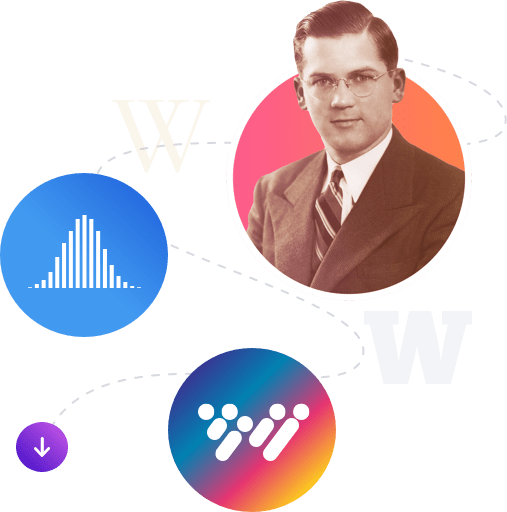
E.F. Wonderlic, Director of Personnel for Household Finance in 1932, had a goal. Fueled by passion and a hypothesis, E.F. was tasked with solving his employer's two biggest hiring challenges. First, Household Finance's hiring managers across the country were inconsistent in their hiring practices. It wasn't much of a surprise, as they were a nationwide company. The second issue was less intuitive, which made it that much more of a challenge. The question was this: how do you identify qualified entry-level candidates if you don't really know who you're talking to?
Immersed in research, E.F. discovered several evaluation techniques used by employers. He noticed they had one common denominator: a gut feeling. He hypothesized that a candidate's general intelligence would be a better predictor of performance than a manager's intuition. With the knowledge that skills tests and interviews weren't enough to vet a candidate, and most general intelligence tests averaged well over three hours, E.F. set out to invent a more efficient vehicle for measuring cognitive ability.
Not only did he prove his hypothesis, he also created the first short-form intelligence test. This completely reinvented intelligence testing could be finished in 12 minutes with 50 questions. The Wonderlic Personnel Test compares in reliability, validity, and quality to the most rigorous intelligence tests around. Keep in mind that this took place in the 1930s, when big data was not seen as a resource. E.F. Wonderlic was the pioneer who proved that data was the key to informed hiring decisions.